
GPS evidence, attached to the punch
When somebody asks whether a crew was on site, the answer shouldn't depend on who remembers what. Every CrewAware punch carries its location — and the jobsite's own boundary decides what gets flagged.
Evidence where the record lives
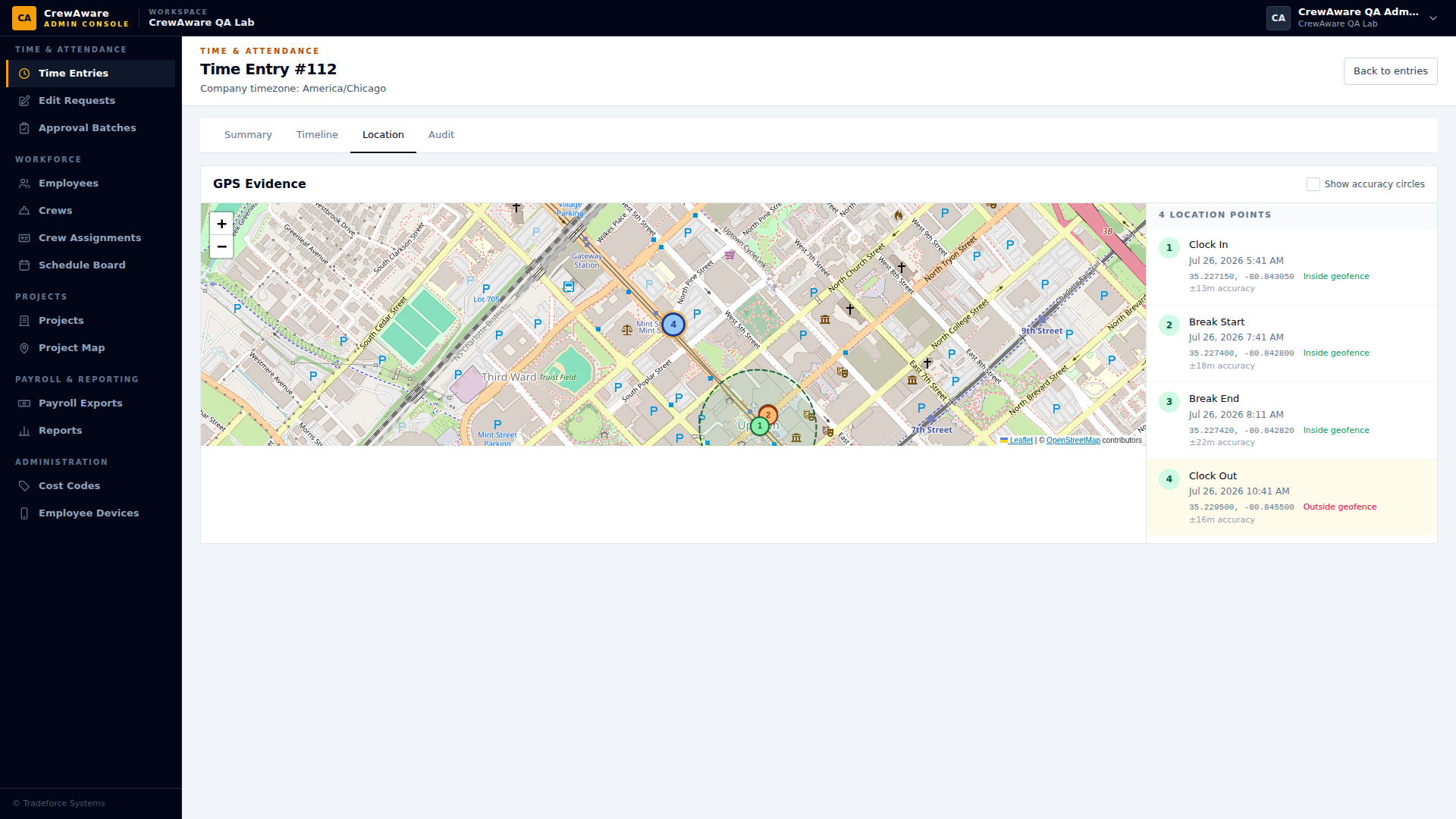
GPS in CrewAware isn’t a separate tracking product bolted onto a timeclock. It’s part of the time record itself: open an entry, open its location, and see where each punch happened.
Accountability, not surveillance
CrewAware records location at punch events — clocking in and clocking out. It is not continuous background tracking, and it does not follow workers who are off the clock.
That line matters twice. It’s what makes CrewAware easy to stand behind with a crew — you’re verifying the punch, not following the person. And it’s what keeps the record clean: evidence exactly where a question could arise, nothing collected for its own sake.
When a device can’t provide a location, the record says so plainly. CrewAware never invents a dot on the map.
Flags start conversations with context
A punch from outside the project’s geofence doesn’t bounce, and it doesn’t disappear — it gets flagged. The office sees it in review with the map open: sometimes it’s a parking lot across the road, sometimes it’s a crew on the wrong job. Either way, it’s a two-minute conversation with evidence instead of a Friday argument without any.
14-day free trial · No card required
Location and geofencing questions
When does CrewAware collect a worker's location?
Only at clock events — clocking in, clocking out, starting or ending a break, and transferring between projects. Each of those captures one location fix and its accuracy, and attaches it to that punch. There is no background tracking, no periodic check-in, and nothing recorded between punches or after a worker clocks out.
What happens if someone punches outside the geofence?
The punch is accepted and flagged for review. CrewAware's geofence settings are warn-and-flag or off — there is deliberately no mode that blocks a worker from clocking in. Blocking a real punch on a GPS reading is how a jobsite ends up with untracked hours and an argument.
What if GPS is unavailable, denied or inaccurate?
Those are recorded as what they are. A denied permission, a disabled service, an unavailable fix, a low-accuracy reading and a stale one are each distinguished on the record and are never reported as though the worker was somewhere they should not have been. CrewAware does not invent a dot on the map.
Do we have to use geofencing at all?
No. Geofence evaluation can be switched off for your company, and punches still carry their location evidence. You can also define fences on some projects and not others — a geofence is drawn per project, by you, on the project map.
Do we have to tell our workers about this?
Yes, and it is your responsibility to. Monitoring-notice rules vary by state and by jurisdiction, and CrewAware records punch locations for your company, on your instruction. Telling your workforce what is recorded and when is part of running it lawfully — the terms say so plainly.